The definitive guide to road freight visibility in Europe
The definitive guide to road freight visibility in Europe
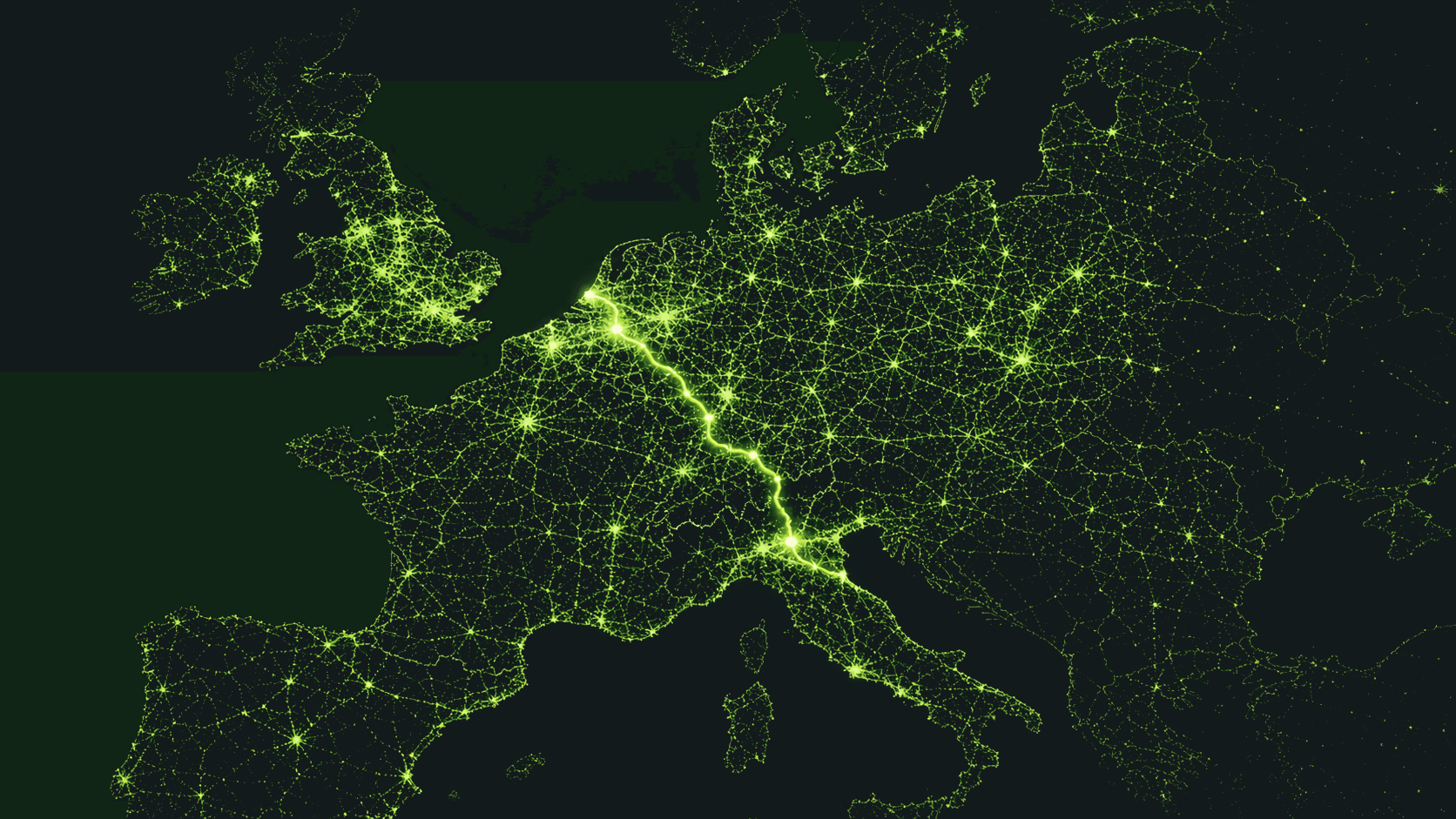
Real-time transport visibility — knowing where every shipment is, what state it's in, when it will arrive, and what it is costing you in fuel, CO2 and delays — is no longer a nice-to-have for European road freight. It is the baseline your customers, regulators and insurers now expect. The thing that makes Europe hard is not the technology. It is the fragmentation: 27 countries, hundreds of third-party telematics vendors, and multi-layer subcontracting on every third order. This guide walks through what real-time visibility actually means, the six data streams that matter, where operators get stuck, and a practical architecture for building a visibility layer that holds up on a real European fleet.
Why Europe is the hardest place in the world to do road freight visibility
Visibility in long-distance road freight started in North America. One language. A small set of federal rules. A handful of large telematic providers. A reasonably standardised trailer pool. A US visibility platform can cover a large share of national ground freight with maybe two dozen integrations and a Samsara account.
Europe is different. The EU road freight market is worth around €400 billion a year and moves roughly three quarters of all overland goods — but it runs across 27 member states with different cabotage rules, different toll systems (Toll Collect, Viapass, ASFA, GO, HU-GO, and the rest), different language and paperwork conventions, and a carrier population still dominated by small and mid-sized operators. Roughly 600,000 licensed road freight operators are active in the EU, and around 95% of them run fewer than ten vehicles. The long tail is a real tail, not a marketing phrase.
The consequence is that no single telematics vendor has more than single-digit market share at a European level. Any shipper, freight forwarder, logistics service provider (LSP) or large carrier with a serious network is, whether they like it or not, running a multi-vendor, multi-subcontractor, multi-country operation — and that is the operational reality any visibility platform has to fit into.
Three forces are now compressing the timeline for that platform:
- Customers asking for per-shipment ETA, emissions and exception data at tender time, not at year-end.
- Regulators tightening — CSRD (sustainability reporting), Mobility Package (driver hours, return-to-base, posted workers), eCMR (the digital consignment note), and F-gas / temperature compliance for refrigerated loads.
- Insurers and brokers repricing cargo risk on the back of record cargo crime (TAPA EMEA logged 557 cargo-crime incidents in December 2025 alone) and starting to discount premiums for carriers with provable visibility controls.
You cannot solve any of the three with a call to the driver and a spreadsheet.
What "real-time transport visibility" actually means
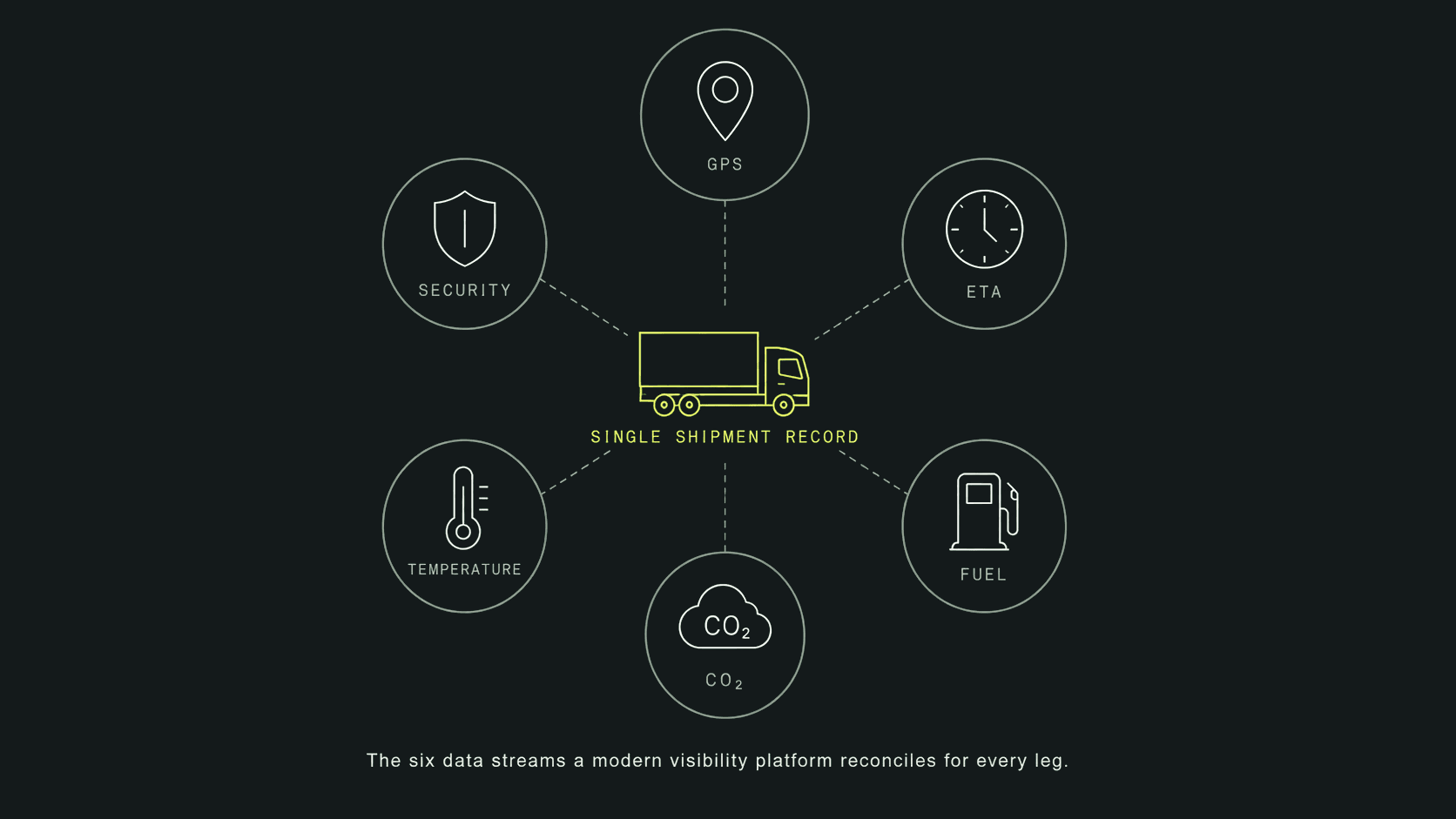
The market has absorbed the abbreviation RTTV (Real-Time Transport Visibility) in the last five years, and Gartner has turned it into a Magic Quadrant. Marketing departments have since stretched the term to cover everything from a plate-tracked ETA to an AI-powered "decision intelligence platform". For working purposes, RTTV for European road freight is the combination of six data streams, in one place, for every leg of every shipment — including the ones you subcontract.
- GPS position and movement. Where the tractor is, where the trailer is, how fast, where it stopped and for how long. The foundation layer. Worth very little on its own, but the denominator for everything else.
- ETA prediction. A dynamic estimated time of arrival for pickup and delivery, recomputed continuously from the live GPS feed, the planned route, traffic conditions, driver hours, border-crossing times, and historical performance of the carrier on that lane. An ETA that does not change for three hours after the truck has clearly left the route is not an ETA. It is a calendar appointment.
- Fuel and energy consumption. Litres per 100 km (or kWh per km for battery-electric), idling time, drive style — read from the vehicle's FMS (fleet management system) or CAN bus. This is what makes Scope 1 and customer-facing Scope 3 numbers believable.
- CO2 emissions per leg and per order. Calculated per leg using measured fuel (primary data) where available, rolled up to order level, attributable to a specific customer and lane. Aligned with ISO 14083 and the GLEC Framework so the resulting number holds up under a CSRD assurance review.
- Temperature and cold-chain status. For refrigerated loads: setpoint, return air, supply air, door events, F-gas-related data where required — stored and timestamped for a traceable record.
- Security and cargo-integrity events. Door open/close, unplanned stops, route-corridor deviations, geofence entries and exits, coupling changes, tacho state, driver-identity changes. The layer that differentiates a tracking tool from an actual security posture.
Any one of those is useful. The point of a visibility platform is that the same shipment shows up in the same record with all six streams reconciled against each other — something no individual telematics vendor delivers today, because no individual telematics vendor is present on every truck in Europe.
The integration problem: why Europe is harder than the US
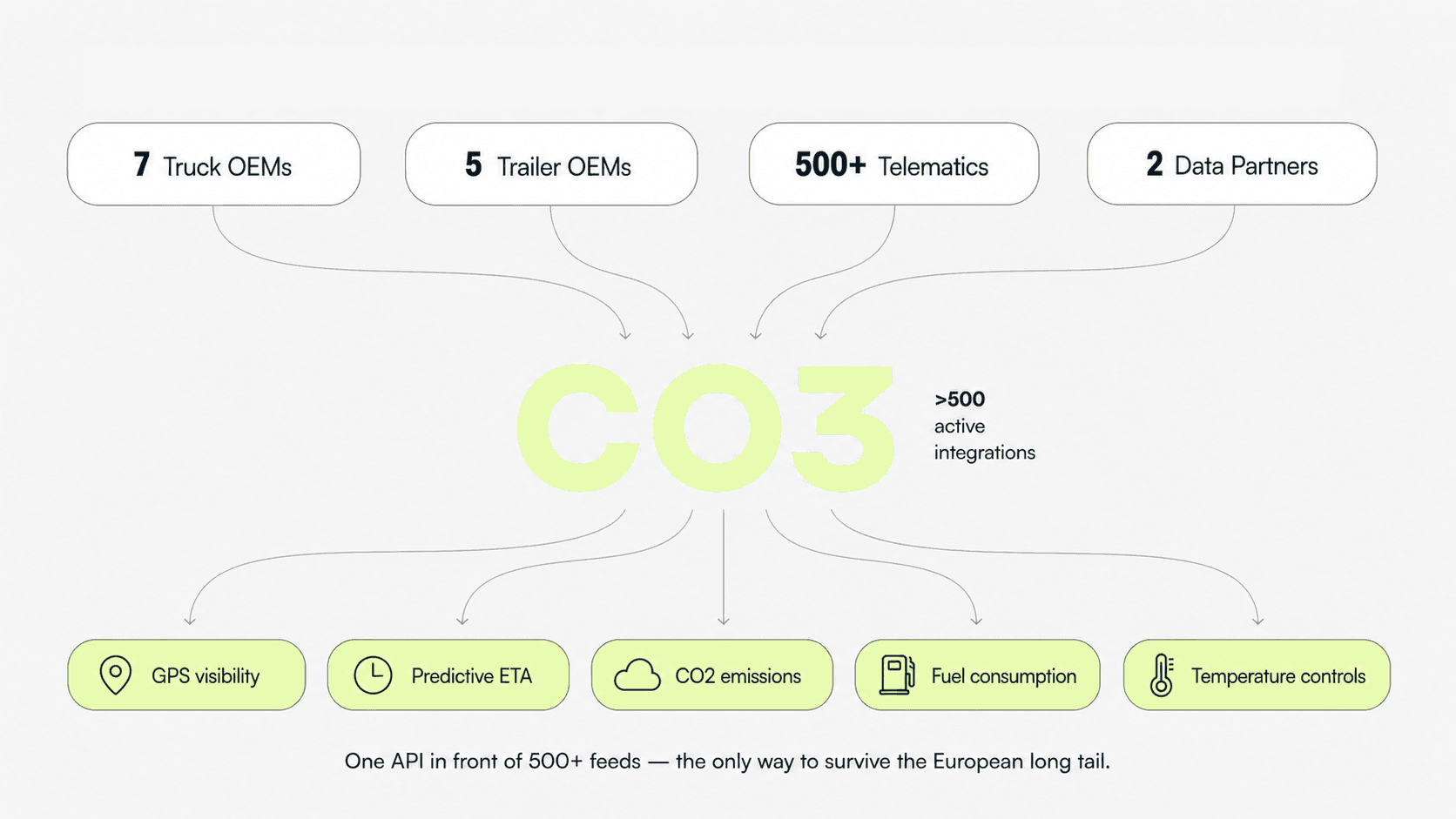
The technical challenge underneath every RTTV product is the integration layer. Ingesting, normalising and timestamping data from every telematics unit on every truck in every subcontractor's yard — and doing it in a way that the data arrives within a minute, not once a day at 02:00 as a batch CSV.
In Europe that means reading from, at minimum:
- Truck OEM feeds: Volvo Connect, Scania Fleet Management, Mercedes Fleetboard, MAN TeleMatics, DAF Connect, Renault Optifleet, Iveco Easy Way, Ford Fleet.
- Trailer OEM feeds: Schmitz TrailerConnect, Krone Telematics, Kögel Telematics, SDC. Each with their own event catalogue for braking, coupling, door status, axle load and temperature.
- Third-party telematics: Webfleet, Transics, Astrata, Continental VDO, Geotab, Frotcom, Microlise, Samsara-EU, and a long tail of national providers.
- Cargo IoT: Nexxiot, Traxens, Sensitech, plus an expanding list of battery-powered Bluetooth/LoRa/5G trackers for high-value or sensitive shipments.
- Tachograph and driver-ID systems: remote DDD downloads, tacho event streams, driver-card events under Smart Tacho 2 (in force on new EU trucks since 21 August 2023).
- Refrigeration units: Thermo King, Carrier Transicold, Lamberet — over APIs, local dataloggers, or trailer-integrated feeds.
Each vendor has its own API semantics, its own event definitions, its own authentication model, its own update cadence, its own terminology for the same physical phenomenon, and its own notion of "real time" (which ranges from ~10 seconds to "within 15 minutes"). Multiplied across 500+ vendors, this is the most underestimated part of the RTTV business — and the one every in-house build eventually capsizes on.
A useful rule of thumb: the cost of building and maintaining a European telematics integration is not the cost of the first connector. It is the cost of the hundredth, three years later, once five of them have silently changed their auth scheme and two of them have been acquired.
Where European operators get stuck
In conversations across carriers, customers and LSPs, the same four blockers come up again and again.
The subcontractor blind spot
On a typical European network, 30–40% of volume runs on subcontractors. For your own trucks, you have full telematics. For subcontractors, you have, at best, a manifest and a driver phone number. Pickup and delivery slots slip without warning. Emissions disappear into a default factor. Exception management reverts to a WhatsApp group at 23:40. Closing the subcontracted gap — with the same richness of data as own-fleet — is the single biggest unlock most European networks have available.
Too many telematics systems, too few common fields
A mid-sized carrier with a growth-by-acquisition history typically runs five or six telematics systems in parallel. The operations team has learned to tolerate this by picking one as the "system of truth" and ignoring the rest. The commercial cost is hidden: lanes run on the "wrong" system are under-reported, drive-style data is never compared across depots, and shipper-facing reports are always 48 hours late because someone has to copy CSVs.
ETAs that are accurate in the brochure, not on the motorway
Every visibility vendor claims 10% or better ETA accuracy. On a clean long-distance A-to-B run, most do. On a real European network — cross-border, with a groupage leg, a 45-minute rest stop, an eCMR upload, and a tight Rotterdam drop window — observed accuracy drops sharply. The difference between a marketing claim and an operational one is whether the ETA model is trained on the specific lane, the specific carrier, and the specific time of day — or on a continent-wide average.
Data quality that nobody owns
Every telematics feed has quirks: ignition events that fire twice, geofences that drift, odometer rolls that double the monthly distance total. Without a data-quality scorecard that flags these at the integration level, every dashboard downstream quietly absorbs the noise. The classic symptom is the "CO2 number that looks about right but the fuel number doesn't match" — meaning one feed is corrupt, and nobody has a way to tell which.
A practical reference architecture for European RTTV
A common pattern has emerged across European visibility platforms for how to build this well. It has four layers, and the tension between DIY and buy sits at each one.
Layer 1 — Integrations. One connector per telematics vendor, truck OEM, trailer OEM, tacho, reefer, and cargo IoT device. Read-only, API-first where possible, with a fallback to CAN/FMS export or file drop where the vendor is behind. CO3 today runs 500+ live integrations across Europe and adds around 20% more a year. The integration layer is not a feature; it is the moat.
Layer 2 — Normalisation. A common shipment and event model. One definition of "stop", one definition of "leg", one definition of "door open", one definition of "ignition on". Units normalised to SI (or an explicit conversion). Every inbound event tagged with its source, its original timestamp, and the platform timestamp. This is the layer that lets a shipper compare two carriers on like-for-like data, and lets an auditor trust the result.
Layer 3 — Exception management & actionable insights. Four things happen here. First, multiple feeds for the same asset (tractor GPS + trailer GPS + cargo IoT) are cross-checked, with disagreement flagged as an event in itself. Second, raw events are enriched with business context from the TMS — order, customer, lane, planned route, appointment windows. Third, derived metrics are computed continuously: dynamic ETA, per-leg CO2, dwell time, exception severity, route-corridor deviation. Fourth, notifications or alerts are released based on user preferences for any combination of events, incidents, or deviations — for both raw data inputs or calculated outputs.
Layer 4 — Exposure. One API for systems (TMS, ERP, ESG platform, broker portal, customer EDI), one UI for humans (control tower, ops, carrier scorecards), one export for auditors. A platform that forces the user to choose between "dashboard" and "API" has already lost the argument — in modern operations the same data has to feed both.
How CO3 does this today. CO3 is positioned as the aggregation and normalisation layer (Layers 1 and 2) and a significant part of the reconciliation and enrichment layer (Layer 3). The core product exposes a single API for GPS, ETA, fuel, CO2 and temperature. CO2 emissions are calculated per leg with a three-tier method hierarchy — PRIMARY (measured fuel or energy), HYBRID (real distance from telemetry + default coefficients), MODELLED (shortest feasible distance with uplift + defaults) — aligned with ISO 14083 and the GLEC Framework. Each leg returns a calculationMethod field and a primaryDataShare metric. Legs are mapped automatically to GLEC Transport Chain Elements (TCEs), and "active leg" reconstruction handles trailer swaps and recouplings without manual input. ETA prediction is delivered in real time with continuous recomputation. Temperature compliance is delivered for refrigerated trailers with event-level granularity. Current scope is road-only, for completed orders; live emissions on in-progress orders are on the roadmap but not yet in production.
![A four-layer horizontal stack: Integrations → Normalisation → Reconciliation & Enrichment → Exposure (API + UI + Audit). CO3 logo sitting across layers 1, 2 and most of 3. Caption: A reference architecture for European road freight visibility.]](/_next/image?url=%2Fapi%2Fmedia%2Ffile%2F89021ba2-d9fd-4b02-b4e5-86455901cbbe.png&w=3840&q=75)
Build, buy or aggregate: the three serious options
Road freight executives who reach this point in the discussion usually ask the same question: do we build this, buy it, or sit behind an aggregator?
Build. Typically attractive to carriers with strong in-house IT and 100+ own tractors. The first two or three integrations feel manageable. The real cost lands at year three, once the long tail has caught up and a team of four is permanently firefighting broken connectors. Almost no one builds a European-scale network from scratch twice.
Buy point solutions. Using the OEM's own telematics portal for each truck brand, or a single-vendor third-party like Webfleet across the own-fleet, and then accepting limited visibility for subcontractors. Works for a smaller fleet with homogeneous assets. Breaks the moment subcontracted volume matters commercially.
Sit behind an aggregator. One integration for you (to the aggregator), and the aggregator absorbs the complexity of the 500+ downstream feeds. The shift is from a fleet telematics spend to a data platform spend. In practice this is the dominant pattern at European scale — and the only one that survives the subcontractor problem without manual re-keying. Especially relevant for companies relying on third-party subcontractors to move freight.
Aggregators differ in three places worth pressure-testing: integration count and freshness (how many live, how quickly new ones ship, how quickly broken ones are restored), data-quality controls (is there a scorecard, or is every inbound feed assumed good), and whether the API is truly one consistent model across every feed or a thin veneer over still-separate data shapes. The third of these is the one an engineering buyer should personally test before committing.
Getting started without ripping anything out
A common objection from operators is: "We already run two telematics platforms and half a TMS upgrade, we cannot start a third project." Fair. The good news is that a visibility aggregator sits on top of what you have, not underneath it. A pragmatic path is three steps.
Step 1 — Inventory what you have. For every depot, every own-fleet asset, every subcontractor on active contract: list the telematics vendor, the API availability, the data fields exposed (fuel? door? axle? temperature?), and the current update cadence. Most operators discover at this step that 60–80% of their fleet already emits primary data somewhere — it just isn't reaching ops.
Step 2 — Connect a pilot lane. Pick one high-value corridor (e.g. Benelux → Northern Italy, a reefer lane with tight temperature windows, or a high-theft-risk electronics run). Connect every relevant feed for that lane through an aggregator in sandbox. Run it in parallel with your current system for 4–6 weeks. Compare. The ETA improvement, the dwell detection and the emissions coverage are typically visible inside two weeks.
Step 3 — Roll out by carrier cohort, not by depot. Expand in rings around the pilot — first the subcontractors serving the same lane, then the adjacent depots, then the own-fleet. Rolling out by carrier rather than by geography keeps the data model consistent and avoids the "six depots, six CO2 methodologies" anti-pattern.
Most operators get from pilot to first customer-facing visibility report in 8–12 weeks.
A ten-point self-assessment: is our road freight visibility fit for 2026?
A fifteen-minute internal audit. Each "no" is worth a conversation.
- We can show the live GPS position of every own-fleet truck and every subcontracted truck carrying our customers' goods. Y / N
- Our ETA for the next scheduled stop is recomputed at least every 15 minutes and incorporates the planned route, live traffic, and driver hours. Y / N
- For at least 70% of volume, our fuel burn per leg is measured from the vehicle — not inferred from distance. Y / N
- Our CO2 number per shipment is calculated leg-by-leg and aligned with ISO 14083 / GLEC. Y / N
- Refrigerated loads expose setpoint, return air and door events into the same record as GPS and ETA. Y / N
- When a truck parks outside an approved location, deviates from its planned corridor, or opens a trailer door off a scheduled stop, an alert reaches a named human within 60 seconds. Y / N
- We can deliver shipment-level visibility to our shipper customers — by API, EDI or portal — without manual copy-paste from the carrier's system. Y / N
- Our subcontracted volume appears in the same reports and dashboards as own-fleet, with a clearly labelled data-source field. Y / N
- We can produce an end-to-end audit trail for a completed shipment — GPS trace, door events, fuel, temperature, tacho state, driver ID — without having to chase five separate systems. Y / N
- A new telematics integration for a new subcontractor goes live in days, not quarters. Y / N
A network answering "yes" to 8 or more is operating at modern European standard. A network answering "yes" to 4 or fewer is losing tenders to one that answers 8 — and is almost certainly also losing margin invisibly on dwell, fuel and emissions reporting.
CO3 can run this audit with your team in a 60-minute working session and a two-week data read.
What to watch in the next 12–18 months
- AI-native control towers. The first wave of "agentic" visibility — proactive outreach to a carrier when a delay is predicted, automated re-booking, automated emissions reporting — is already in the market in 2026. The interesting question is not whether AI appears, but whether it is grounded in real underlying data or hallucinating on top of thin telematics. An AI layer is only as honest as the feed beneath it.
- eCMR going mandatory. The digital consignment note is becoming default across the EU through the late 2020s, with several member states (Spain, France, Belgium, the Netherlands, the Nordics) moving early. Once paperwork goes digital, visibility platforms become the natural place to hold and timestamp the full legal record of the shipment — making the platform choice a compliance decision, not just an operations one.
- Mobility Package enforcement tightening. Return-to-base, posted-worker rules and cabotage limits are being enforced more actively by national authorities. Visibility platforms with clean border-crossing and driver-hours data turn from a nice-to-have into audit infrastructure.
- Insurer-led visibility discounts. As cargo crime and claim frequency rise, the first major European cargo insurers are publicly offering premium discounts for shipments carried on instrumented fleets with verifiable secure-parking discipline. Expect this to harden into a formal risk-score model over the next 18 months.
Closing thought
Road freight visibility in Europe is not a screen. It is an architecture. The operators who will be winning the RFPs of the late 2020s are the ones whose visibility layer can answer, for any shipment on any subcontractor on any lane, the same six questions — where it is, when it will arrive, what it is burning, what it is emitting, what state it is in, and what just went wrong. You cannot get there with a truck-OEM login and a spreadsheet. You can get there with a platform that treats the 500-vendor long tail as its own job.
See how CO3 aggregates 500+ telematics integrations into one European road freight visibility feed.
Glossary
- RTTV — Real-Time Transport Visibility. Live operational data about a shipment from pickup to delivery.
- TMS — Transport Management System. The operations-planning software that books and manages shipments.
- FMS — Fleet Management System. The vehicle-side software/hardware that reads CAN bus data (fuel, speed, engine state).
- CAN bus — The internal network inside a modern truck that carries engine, drivetrain and sensor signals.
- Telematics — Hardware and software that collects vehicle data (position, engine, driver) and transmits it remotely.
- OEM feed — A data stream provided by the truck or trailer manufacturer itself (Volvo, Scania, Schmitz, Krone, etc.).
- Trailer telematics — A telematics unit fitted to the trailer rather than the tractor — increasingly standard for refrigerated and high-value loads.
- Geofence — A digital boundary on a map; used to trigger alerts for arrivals, departures, or off-route events.
- ETA — Estimated Time of Arrival. For RTTV purposes, a continuously updated one, not a static one.
- Dwell time — Time a vehicle spends stationary, usually at a loading or unloading point. A major driver of operational cost.
- eCMR — The electronic version of the international road-freight consignment note (CMR).
- Mobility Package — The EU legislative package governing cross-border road freight, covering driver hours, cabotage, posted workers and return-to-base obligations.
- ISO 14083 — The international standard for calculating and reporting transport emissions.
- GLEC Framework — The Global Logistics Emissions Council methodology for freight emissions; aligned with ISO 14083.
- TCE (Transport Chain Element) — GLEC's term for a single leg of a transport operation.
- Primary data — Measured data from the actual operation (e.g., fuel burned from the CAN bus).
- Cabotage — A foreign-registered truck carrying domestic shipments inside another member state, within limited rules.
- Smart Tacho 2 — The second-generation digital tachograph mandatory on new EU trucks since 21 August 2023.









.png&w=3840&q=75)